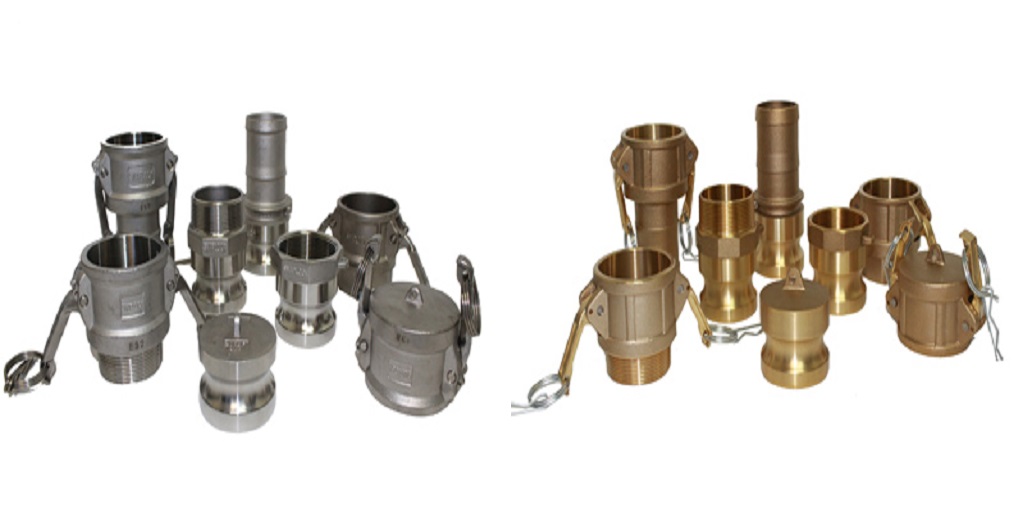
Brass hose camlocks have a great number of use cases in a wide range of industries and applications. A relatively malleable and highly corrosion-resistant alloy of copper and zinc, brass has a wide range of applications in water, oil and gas, as well as in marine applications. Brass is sometimes also used in the food and beverage industry, but for such use it must be certified lead-free.
High-quality stainless steel is generally more expensive, but due to increasingly competitive costs, both 304 stainless steel, and an even more exemplary grade of SS, 316, are poised to replace brass in many of the industries in which it is used. Here’s what you should know.
316SS vs. Brass Hose Camlocks: Features and Performance
For a long time, the competitive price of brass, paired with its corrosion-resistance, chemical stability, and amenable price made it a strong competitor to the use of stainless steel in the manufacturing and installation of camlocks. Brass is also a softer alloy, making it easier to close the arms.
Specifically, 316 stainless steel (SS), is a competitive replacement. Also known as marine grade stainless steel, 316 is chemically similar to 304 except it has more nickel and molybdenum.
As a result, 316SS hose camlocks offer superior corrosion-resistance to 304, despite the higher price. It also offers higher chemical resistance to chlorides and acids than 304, and performance on par with or better than brass.
This is a particular concern when using brass camlocks, fittings or pipes, because chlorides cause dezincification, a process wherein the zinc leaches out of the brass, leaving behind copper – a softer metal that is far more prone to chemical attack.
It’s also worth noting that 316SS is naturally lead-free as lead is not used in the process of manufacturing it. This stands in contrast to brass, to which lead is frequently added to improve its machinability and mechanical properties.
As a result, 316SS is a superior material for use in the food and beverage industry, as well as in brewing. It’s also an excellent alloy for use in areas in which there are high salinity concentrations, such as marine environments and along roadways. It’s also more suitable for use in environments in which there is an increased risk of exposure to acids and alkalis.
Moreover, 316SS is also superior for use in the chemical, pharmaceutical and medical industries. In terms of strength, it performs very similarly to 304 – tensile strength is about the same but yield strength is higher. However, 316SS is significantly harder and stronger than brass.
All in all, 316SS has brass beaten on nearly every front. It offers superior corrosion resistance, strength, hardness, and does not contain lead, which makes it better for use in more sensitive applications in which lead contamination is a prime concern. The one thing brass definitely has is price.
But, with that said, 304 as an alternative to both is sometimes acceptable if a slightly lower degree of corrosion resistance is acceptable. It is also much more affordably priced and offers better strength and durability than brass, and like 316SS is also made without lead.
Need More Information on Hose Camlock Materials?
Whether you’re doing research for your industry’s deployment and use of hose camlocks, based on material, or are simply looking for a new supplier of commercial and industrial fittings and valves, visit Proflow Dynamics.
Their website has a wealth of resources, both informative and physical. Take a look through their collection of hose camlocks and valves (made with a wide range of materials in addition to those covered here) and if you have any questions before buying, get in touch with them at sales@proflowdynamics.com.