
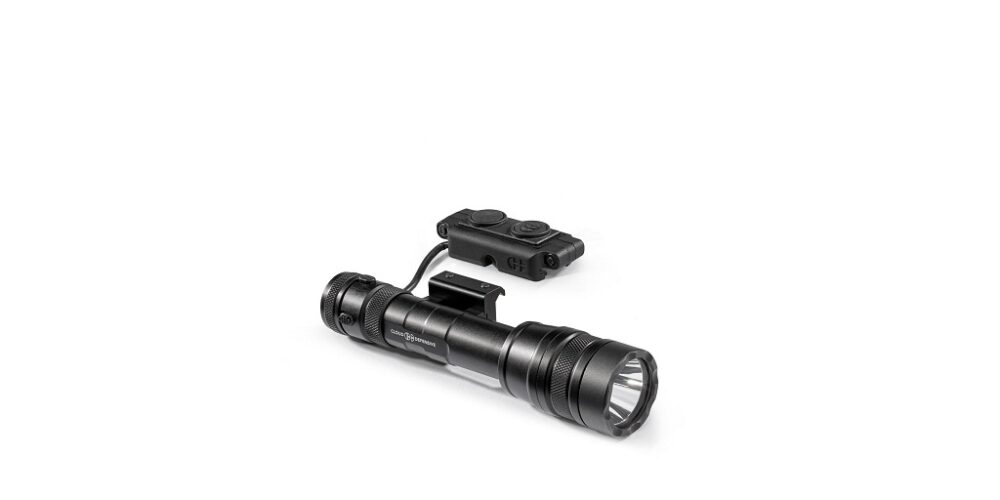


Some rail-mounted weapon lights, like the Cloud Defensive OWL and REIN, are built tough. They are shockproof, dustproof, and waterproof. The OWL even has fully sealed internal circuitry, so even if water and dirt do get in, nothing happens.
But water and dirt don’t only cause problems by getting in. they can cause problems by remaining on the outside of the WML. Case in point: carbon residue and powder fouling accumulating on the lens of a weapon light.
Every time you pull the trigger, your rifle blasts everything in the vicinity of the muzzle with fouling. If your rifle has a ported muzzle device, then the orientation of the ports may make it even worse (or better, depending).
Over time, this residue will accumulate, and the lens of your tactical light will become a dull, foggy brown. Believe it or not, this scenario can present a significant adverse impact on the light’s luminosity and focus, severely inhibiting its efficiency. A severely obstructed lens might drop an LED weapon light rated at 600 lumens all the way down to 400 lumens, or even down to half, at 300 lumens.
Those that offset-mount their rail-mounted weapon lights will experience less of an issue with this particular phenomenon, all things being equal than others who mount their lights at the 3 o’clock or 9 o’clock position, but all WMLs need to be cleaned from time to time anyway.
Fortunately, it’s easy to fix the problem. All you need to do is keep the lens of the weapon light clear with a little bit of routine maintenance.
On Cleaning a Rail Mounted Weapon Light
If you have a tough-as-nails weapon light like the Cloud Defensive OWL and REIN, which are completely insulated against outside ingress, then keeping them clean is mostly a matter of exterior maintenance. Simply wipe down the outside with a damp rag as needed. The hard black-nitride coating, which is exceptionally corrosion-resistant, will do the rest.
It’s the lens cover that you really need to offer a little extra TLC. This is what gets all gritty and foggy from repeated exposure to carbon fouling.
There are two quick ways we have to offer you that can be used to clean off the lens cap of a weapon light: a pencil eraser and a cotton cloth with a little bit of rubbing alcohol.
The great thing about a pencil eraser is that it’s small. Simply apply a little bit of gentle pressure and rub the lens in a small, circular motion. The residue should lift right off. It’s a little bit harder to get into the corners, but the eraser can be shaped into a point for the purpose of reaching around the margins of the lens cap.
When you’re finished, simply wipe away the eraser shavings from the lens with a rag or use a little bit of compressed air to blow them away. Your light will look (almost) as good as new.
Another great way to clear carbon fouling from a lens cap of a tactical flashlight is with a small cotton cloth and a little bit of rubbing alcohol. Rubbing alcohol can be fairly effective at dissolving carbon fouling, dries very quickly and leaves no residue itself.
Simply apply a little rubbing alcohol to the cloth and gently scrub the lens of your rifle light. The fouling should come right off on the rag, leaving your lens cover as bright as the day you bought it.
Questions? Contact Cloud Defensive
If you have any questions about maintaining a rail-mounted weapon like an OWL or REIN don’t hesitate to reach out to them directly at [email protected]. You can also learn more about their gun lights’ specifications on their website, CloudDefensive.com.