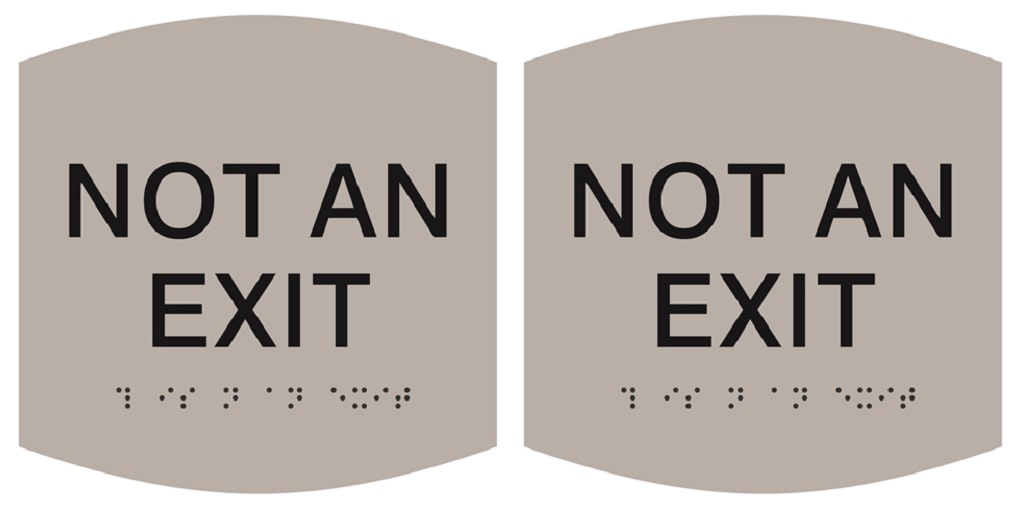
When a crisis strikes, time is critical. For sighted individuals, the clearly installed accessible ADA exit signs offer an immediate, universally understood path to safety. However, this raises an important question: what if these vital signs are not accessible to all occupants?
When time is critical, the absence of tactile and Braille components on exit signs turns a clear path to safety into a maze of confusion for visually impaired individuals.
The High-Stress Barrier
During an emergency, panic often compounds existing challenges. Sighted occupants rely on visual cues, but visually impaired individuals rely heavily on consistent, predictable tactile information and auditory instructions.
Missing or Non-Compliant ADA Exit Signs Create a Severe Disconnect:
- Confusion and Disorientation: If the emergency route involves navigating hallways or multiple doorways, the lack of an ADA-compliant tactile sign near the doorframe means a visually impaired person cannot confirm if the door is a closet, a restroom, or the actual exit. In low-visibility conditions (like heavy smoke), this confusion is lethal.
- Wasted Time: Having to sweep a hand across a wall, searching for an identifier that should be predictably located (as mandated by ADA guidelines), wastes precious seconds that could mean the difference between escape and entrapment.
- Increased Risk of Injury: Disorientation can lead to stumbling, walking into obstacles, or moving toward non-exit doors, putting the occupant and potentially those assisting them at greater risk.
- Non-Compliance and Legal Liability: The absence of ADA-compliant signage is a direct violation of federal law, exposing the building owner or management to potential lawsuits, fines, and mandated remediation costs.
- Undermined Emergency Planning: An emergency plan that relies on occupants using doors without proper tactile identification is fundamentally flawed and fails to account for a significant portion of the population, invalidating the overall safety strategy.
A Failure of Universal Design
Hospitals, schools, government buildings, and other extensive public facilities are ethically and legally obligated to ensure equal access to safety. An exit sign that only serves a portion of the population is, by definition, a failure of universal design, particularly when lives are on the line.
The Role of Braille and Tactile Components:
ADA-compliant exit signs provide the critical, non-visual information necessary during high-stress situations:
- The tactile lettering and Grade 2 Braille confirm the sign’s message (“EXIT”) when visual confirmation is impossible.
- ADA rules dictate the exact mounting location, ensuring that a visually impaired person can reliably find the sign next to the door they are attempting to use.
- Distinctive, loud sounds and tactile vibrations (from strobes) indicate an emergency and where to focus attention.
- Voice annunciation or synchronized sound beacons guide people toward the nearest emergency exit.
- Textured paving or strips on floors warn of hazards, drop-offs, or the proximity of a door.
- Continuous handrails provide a physical line to follow, offering stability and direction in smoke or darkness.
- Two-way communication systems allow people to report their location or condition verbally for targeted assistance.
- Clear, simple, and repeated verbal or tactile instructions (e.g., via Braille signage at a shelter area) on what to do.
- Devices that buzz or vibrate near an exit or key safety feature.
- Non-visual recognition of a door handle’s material (metal vs. wood) or temperature (e.g., a hot handle indicating fire) can inform decisions.
Safety is not an optional feature: it is a fundamental right. Ensure your facility is prepared for every occupant, in every scenario.
To learn more about meeting ADA compliance standards for critical emergency signage, check out Braille Sign Pros for compliant and durable ADA exit signs.