The LNG industry doesn’t play around when it comes to precision—and neither should your dehydration system. Before natural gas can be cooled into a liquid, it must be free from contaminants, especially water vapor. That’s where a natural gas dehydrator earns its keep. Whether it’s for upstream conditioning or safeguarding instrumentation inside explosive environments, these systems ensure the entire LNG value chain runs smoothly and safely.
Why Dehydration Is Non-Negotiable
Water may seem harmless, but in LNG applications, even a trace amount can wreak havoc. During liquefaction, gas is cooled to about -260°F. If moisture is present, it forms ice or gas hydrates—solid crystals that can clog cryogenic heat exchangers and pipelines. The result? Costly shutdowns, safety hazards, and damaged equipment.
Dehydration isn’t just a preventative measure; it’s an operational requirement. A properly installed natural gas dehydrator eliminates this risk by removing water vapor well before the gas reaches sub-zero temperatures.
Explosion-Proof Dryers for Critical Zones
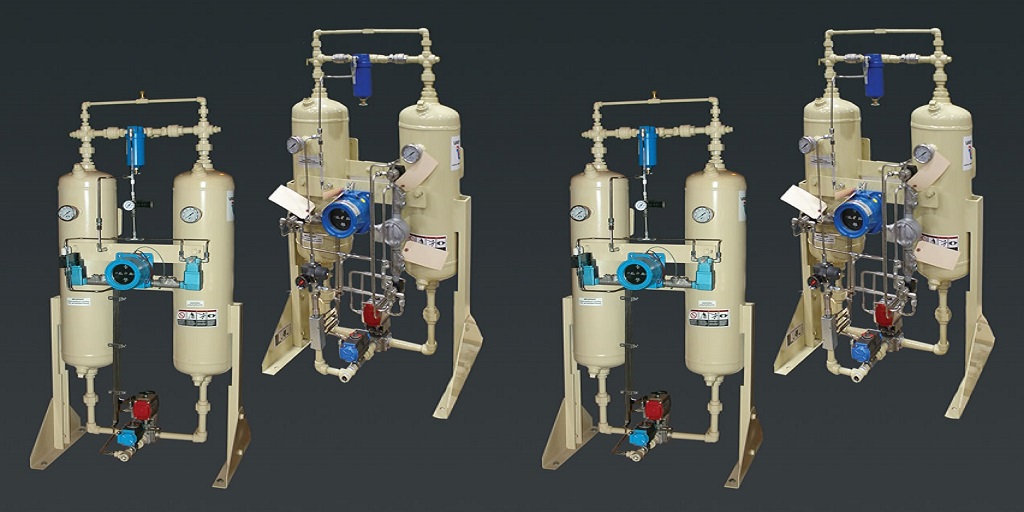
Not every dehydrator is built for hazardous environments—but some are. Explosion-proof regenerative dryers like the HLSXG are specifically designed to operate in Class 1 Division 1 zones, where the presence of flammable gases requires equipment that can’t afford a single spark.
These twin-tower regenerative systems work on pressure swing adsorption, alternating towers to dry the gas while regenerating the desiccant. The bonus? No downtime. The process runs continuously, allowing for steady, low-dew-point performance with minimal manual oversight.
Also important is how the HLSXG handles its purge gas. All vapors and exhaust are directed to a single exhaust port, which can be safely routed to a vapor recovery unit or flare stack. That means better emission control without complicating plant layout.
Where These Systems Fit In LNG Operations
While molecular sieve dryers are the go-to for final-stage dehydration before liquefaction—thanks to their ability to achieve sub -100°F dew points—not all LNG processes require that level of dryness at every stage. Systems like the HLSXG are perfect for:
- Pre-conditioning gas streams before final processing
- Drying instrument or fuel gas lines
- Maintaining safety in explosion-prone plant areas
- Serving as secondary dryers or backup units
They offer a solid -40°F dew point and operate with reliability even in remote or off-grid locations, especially when equipped with low-voltage (12V DC) controls.
Beyond Safety—Operational Efficiency
A solid natural gas dehydrator doesn’t just protect your equipment—it lowers your operating costs. Regenerative systems reuse desiccants, require less maintenance, and avoid the fuel gas consumption typical of glycol-based systems. Some designs, like single-tower deliquescent dryers, may still be used in low-flow or instrument gas settings, but for heavy-duty use in LNG operations, regenerative systems are the gold standard.
If your LNG facility needs a rugged, field-proven solution for moisture control—especially in classified zones—a natural gas dehydrator like the HLSXG is more than a good idea. It’s essential.
To learn more about explosion-proof dryers and regenerative dehydration systems that meet the demands of LNG infrastructure, visit Air Vacuum & Process, Inc. for more product solutions.