Design standards play a critical role in ensuring that foundation systems perform as intended under real-world conditions. For projects using a helical piles foundation, the governing design framework is CSA S447. This standard establishes how loads are evaluated, how installation data is interpreted, and how long-term performance is verified. Understanding why CSA S447 holds authority helps clarify design expectations, reduce approval delays, and support defensible engineering decisions.
Why CSA S447 Carries Regulatory Authority
CSA S447 was developed specifically to address foundation systems that rely on deep load transfer mechanisms. It aligns with national building code requirements and is recognized by engineers, building officials, and regulators across jurisdictions. Unlike evaluation reports or proprietary guidelines, CSA S447 functions as a consensus-based standard that provides uniform criteria for design and verification.
For a helical piles foundation, this means the design process must follow CSA-defined methodologies rather than relying solely on manufacturer recommendations or foreign testing protocols. This consistency allows building departments to assess compliance more efficiently and gives engineers a clear basis for professional responsibility.
Load Capacity Must Be Proven, Not Assumed
One of the core principles of CSA S447 is that load capacity must be verifiable. The standard requires designers to account for soil conditions, installation torque correlations, and appropriate safety factors. Torque alone is not treated as a standalone guarantee; instead, it is evaluated within a broader design framework that includes geotechnical data and performance limits.
This approach directly affects how a helical piles foundation is specified. Designs must demonstrate that axial, lateral, and uplift capacities are supported by measurable data and conservative assumptions. The result is a foundation system that is engineered for reliability rather than optimized purely for speed or cost.
Installation Is Part of the Design Equation
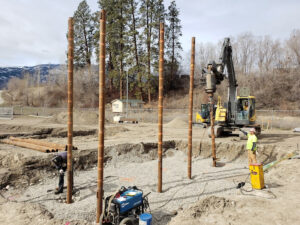
CSA S447 places significant emphasis on installation controls. The standard recognizes that even a properly engineered design can fail if installation variables are not monitored. Requirements around torque monitoring, alignment tolerances, and documentation are integrated into the design philosophy.
For projects using a helical piles foundation, this means installation records are not optional paperwork. They form part of the compliance trail that supports the original design assumptions. Inspectors and engineers rely on this information to confirm that field conditions align with what was designed on paper.
Compatibility With Building Code Requirements
Another reason CSA S447 governs helical pile design is its compatibility with building code performance objectives. The standard is structured to support limit states design principles, ensuring foundations perform safely under both service and ultimate load conditions.
This alignment simplifies plan review and permitting. A helical piles foundation designed under CSA S447 can be evaluated within the same regulatory framework used for other deep foundation systems, reducing uncertainty during approvals and inspections.
Reducing Risk Through Standardized Design
Using CSA S447 helps reduce technical and legal risk. Designs based on a recognized national standard are easier to defend if performance questions arise. Engineers benefit from clear guidance, contractors benefit from predictable requirements, and project owners benefit from fewer surprises.
By contrast, designs based on non-CSA references may face additional scrutiny or require supplemental justification. For a helical piles foundation, following CSA S447 from the outset helps avoid redesigns, project delays, and costly revisions.
Ultimately, CSA S447 provides a common language between design, installation, and approval. For any project relying on a helical piles foundation, adherence to this standard is not just a technical preference—it is the foundation of compliant, durable, and defensible design.
For More Information about Expert Pile Drilling Contractors and Commercial Drilling Service Bc Please Visit: ATLAS PILING.