Let’s just be honest. The popularity of bayonets, and their utility as battlefield implements, has been on the downtrend over the last 100 years.
While they were still popular (and heavily utilized) in the First World War, improvements in range weapons, battlefield tactics, and general technology have severely limited the ability of soldiers to use bayonets in combat.
Be that as it may, they are still issued to troops; in our case, in the form of the M9 bayonet that is official issue with the M16.
Behind the Design of the M9 Bayonet
It was determined over 40 years ago that the M7 needed a replacement, and the Army wanted troops to have a bayonet that could serve as both a tool and a weapon.
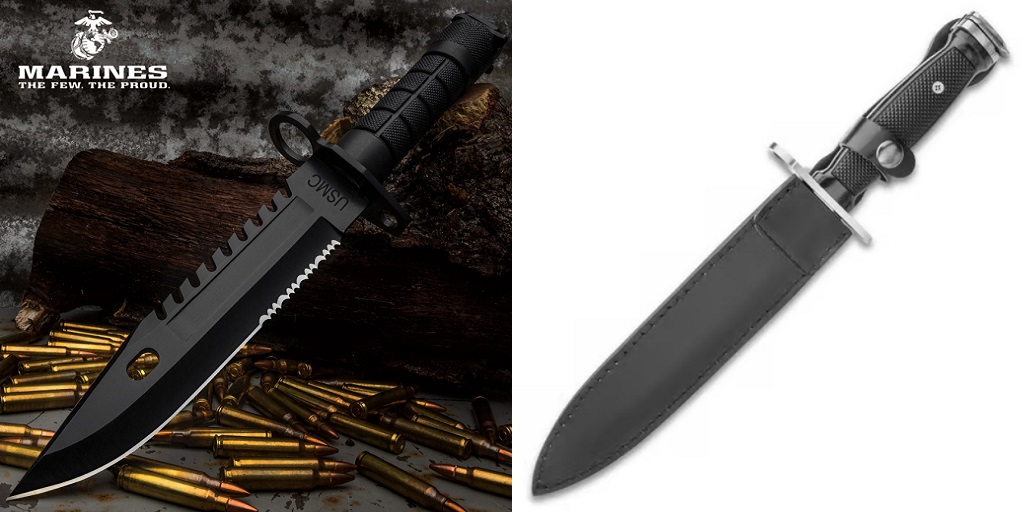
Hence, the M9 was born for compatibility with the M16, and was designed with a 12 inch overall profile, a 7 inch blade, and with a sheath that had a clip for ALICE compatibility.
The M9 also has a barrel ring, and was heavily inspired by a Soviet pattern; ours was just bigger. It also sports a hole in the blade that corresponds to a lug in the sheath, to which it can be joined so that the M9 can be used as a pair of wire cutters. It could also be used as a bottle opener and screwdriver, and thanks to its relatively compact size, could be removed from the rifle and used for general utility and also as a fighting knife.
Complaints
Even though the M9 bayonet did capture features that guaranteed a lot of utility, it wasn’t long before troops that were actually issued it started to gripe.
Right out of the gate, the size of the M9 drew criticism. For the last century, bayonets have been shrinking, but the M9 actually was larger and heavier than the M7 that it replaced. It’s not like the M9 was as heavy or cumbersome as a sword-style bayonet, but the size and weight still drew observation, and not all of it popular.
Another criticism of the M9, and this is one of the worst of them, is that it is made with a rod tang, rather than a full tang. While a rod rang is better than a partial tang and better still than a rat-tail tang, it is nowhere near as strong as a full tang.
Worse yet – and to some this is inexcusable – is that the blade and tang are not a one-piece design. The blade is designed to thread onto the rod, which creates a critical weak point.
Another problem with the M9 were its serrations. They are too broad and too shallow to cut effectively, making them more of an ornamentation than an actual feature that can be used in the field.
Lastly, the edge geometry was not the best. It’s very hard to get a fine edge on the M9, and on top of that, the somewhat oblique point is not ideal for penetrating. It can be an effective bayonet, that much is true, but it requires more effort to use than other designs.
So, all in all, because the designers tried to make the M9 great at everything, rather what they did was make it average at most things and bad at others.
That said, it is still a cool design and it is not without its virtues.
Where to Get an M9 Bayonet Replica
Here for an M9 bayonet replica, either for your collection or your rifle? Get it online at BudK; they carry M9, M7, and M1 bayonet replicas, along with tons of other cool bayonets, like 1905, German M98, British P1903, and Japanese Arisaka Type 30 replicas.
A picture says a thousand words. Visit their website to see what they offer today.